3D Lighting Types

A screen shot from the game Trine 2 showing different types of lighting affects
Following on from our previous article on the basics of 3D Modelling we now continue on to look at lighting and illumination in 3D scenes. 

3D models and scenes can be illuminated like real world objects but realistically there are a set number of well established 3D lighting techniques, and the type of scene usually determines which ones are the most appropriate. For example, techniques that work well in an interior environment  usually dont work as well in an outdoor scene. Similarly, "studio" lighting for products or characters requires a very different approach to lighting for an animation or film. In the end, every situation is different, and through trial and error (and reading this article) you will find out the best light types for every scene.


Here are some of the standard lighting options found in most 3D software suites...


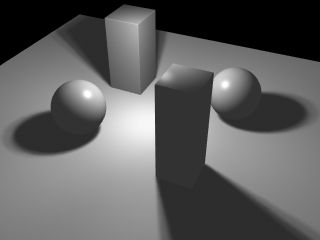
  • Point/Omni Light: A point light casts illumination outward in every direction from a single, infinitely small point in 3D space. Point lights are useful for simulating any omni-directional light source such as light bulbs or candles.
A point light casting light in all directions
  • Directional Light: Unlike point lights, which occupy a specific location in a scene, a directional light is used to represent an extremely distant light source, like the sun or the moon. Rays cast from directional lights run parallel in a single direction from every point in the sky, and are typically used to simulate direct sunlight. Because a directional light represents a distant light source, its x,y and z coordinates does not effect the scene in any way. The rotation/direction however, does has any effect on how the scene will be illuminated, effecting the angle and length of shadows for example.
The parallel lines of a directional light are visible in this image
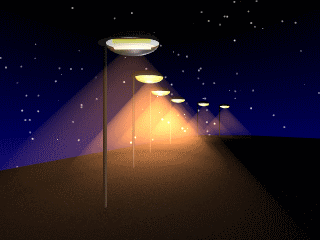
  • Spot Light: Spot lights in 3D applications are fairly self-explanatory and are very similar to their real-world counterparts. A spotlight emits a cone shaped light field from a single point. Spotlights are often used for three-point studio lighting, and also for simulating any light fixture where there is a distinct visual falloff from light to dark such as with streetlights, desk lamps, stage lighting or just actual overhead spotlights.
Spotlights used to simulate the cone of light from a street light
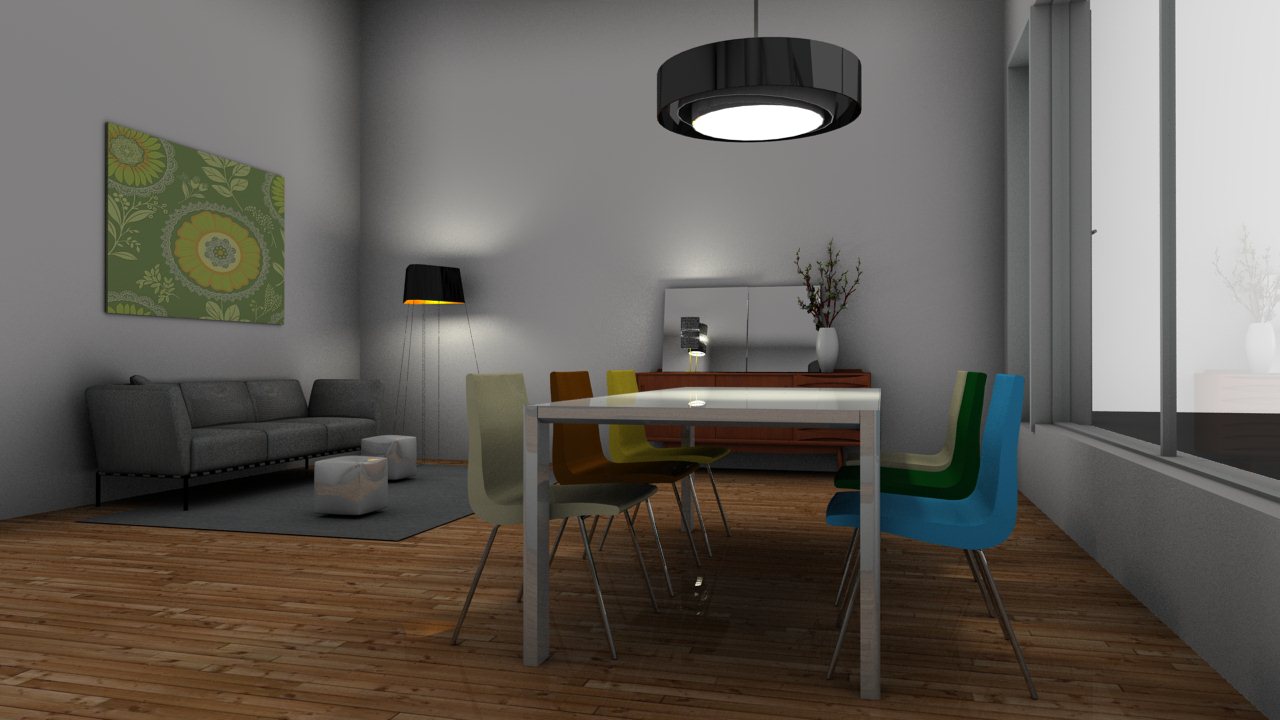
  • Area Light: An area light is a physically based light that casts directional rays from within a set boundary. Area lights have a specific shape (either rectangular or circular) and size, making them very useful for simulating florescent light fixtures, back-lit panels, and other similar lighting features. Although area lights do have an overall directionality, they do not emit parallel rays like a directional light would.
An area light used to simulate a back lit fluorescent panel

  • Ambient Light: An ambient light casts soft light rays in every direction, and can be used to elevate the overall level of diffuse illumination in a scene. Unlike the other light types it does not mimic any particular type of real world lighting. It has no directionality, and therefore casts no ground shadow, however it is not truly omni-directional like a point light. A common use for this tool is to softly light the areas of a scene outside the influence of the main light in a scene or to elevate the overall level of diffuse and soften dramatic shadows created by another light in a scene.
Ambient light is used here to illuminate the areas outside the influence of the main lights


Global illumination is not a light type in 3D software but rather an overall setting that can be edited within a scene. Global illumination is a process where the computer calculates the bouncing of light. In real life light rays bounce from the surface they hit. Some of the light is absorbed by the surface and the rest is reflected. Reflected light rays pick up some of the color of the bouncing surface. Global illumination is a processor intensive task which can produce realistic illumination into 3D renderings.

The light types we've discussed here can be used for anything from simple three-point studio lighting to complex animated scenes that require multiple lights. It's very rare that a scene will only include one light type so they're almost always used in conjunction with one another. So now that you know the basics of 3D lighting why not give it a try yourself?

Next up in our series on 3D Modelling and Animation is 3D Materials and Textures.


3D Modelling Basics

A 3D Model in Progress

This article on 3D modelling will the be the first of 5 articles on the topic of 3D Graphics and Animation. In this instance, 3D graphics means computer generated three-dimensional graphics. In 3D graphics, elements are visualized by creating three-dimensional models out of them. The final image is rendered from a virtual scene that utilizes several elements which are familiar from real life such as lights, materials and cameras. 3D graphics can be seen in multiple different forms such as an image, an animation or real time visualization inside of a computer game. 

The creation of 3D graphics is a complicated process and therefore is, in my opinion, easier to understand when discussed in small pieces, hence the 5 article series. First up it's 3D Modelling which refers to the creation of the 3D model itself.


3D Modelling - The Parts...

A 3D model is a mathematical representation of an object. 3D modelling can be compared to sculpting. Artist builds or moulds a 3D object by taking into account all different sides and angles. 3D models consist of smaller elements (vertex, edge, face, polygon) which can be manipulated individually in whatever software you are using to model your 3D object, such as Blender, Maya or 3D Studio Max.

Vertex:

vertex

Vertex is the smallest building block of a 3D model. Vertex is a point where two or more edges meet and where corners of faces or polygons meet. In a 3D model a vertex is shared between all connecting edges, faces and polygons. Transforming a vertex affects all connected edges, faces and polygons.

Edge:

edge
Edge is a line between two vertices. Edges are border lines of faces and polygons. In a 3D model an edge is shared between two adjacent faces or polygons. Transforming an edge affects all connected vertices, faces and polygons.


Face:

face

Face is a triangle. Face is a surface between three corner vertices and three surrounding edges. Transforming a face affects all connected vertices, edges and polygons.

Polygon:

polygon
Polygon is an even surface which has four or more corners and is made of two or more faces. A polygon is surrounded by edges and has a vertex in each corner. Animated high quality 3D characters are often made mostly of four-sided polygons. Polygons with 5 or more sides can cause problems in deforming surfaces such as a human face.


3D Modelling - The Techniques...

3D models can be created in many different ways. The choice of modelling technique depends on the requirements and the complexity of the object. The following list describes some of popular 3D modelling techniques:


Standard Primitives and Modifiers:

Primitives and Modifiers
Many 3D software packages include tools for creating standard objects such as boxes and spheres easily. One of the simplest 3D modelling techniques is to combine these standard objects to create complex 3D models. 3D Studio MAX includes standard objects such as sphere, cube and tube. These standard objects can be modified through their parameters (radius, height etc.) or through special modifiers (stretch, bend etc.). By combining several different standard objects and by modifying them, one can create complex 3D models.


Polygon Modelling:

Stages of Polygon Modelling
Complex objects are often modeled polygon by polygon. 3D software packages include many efficient tools for creating and manipulating polygons.
Subdivision surface means a surface which is created by dividing the original 3D model into smaller polygons. At the same time 3D model's corners become rounder and the surface becomes smoother. Subdivision surfaces is a very popular modelling technique. The advantage of a subdivision surface is the fact that one can create a coarse 3D model which is then automatically subdivided into a smoother surface.
A Polygon Model Before and After Subdivision

Boolean Operations:
The starting point of Boolean operation is two overlapping 3D objects. Boolean operations are prone to error and the resulting geometry might have underlying problems.
Boolean Modelling
Boolean operation has four possible results:

The 4 Possible Outcomes of a Boolean Operation 

  • Union: Two 3D models are combined and the unnecessary geometry inside of the Models is removed.
  • Intersection: Overlapping a part of the two 3D objects.
  • Subtraction (A-B): Object A is subtracted from object B.
  • Subtraction (B-A): Object B is subtracted from object A.


NURBS:

NURBS stands for Non-Uniform Rational B-spline. In NURBS modelling, lines and surfaces are not manipulated by moving vertices, edges, faces or polygons. Instead NURBS surfaces and lines are manipulated by special control points. The following 2 techniques make use of NURBS.

Solid of Revolution:

A cross section and the object created by a solid of revolution
Solid of revolution is made of one line. The line represents a half cross-section of the object. Solid of revolution is created by revolving the line around a specified axis which then creates the form of the object in 3D.


Lines:

A 3D object and the cage of lines used to create it

3D objects can be created by creating a cage of lines which can be then be converted to a solid 3D surface. This can be a difficult technique to master as it can be hard to visualise the outcome of the lines once they are solidified but once mastered it allows for very quick modelling of objects.


Now that you understand the basics of 3D modelling, why not give it a try, it won't cost you a penny either! We recommend the free software Blender to get you started. The turorials linked to below are also a good place to learn the basics of modelling 3D objects. Or, if you're not ready for that yet, read the next tutorial in the 3D Modelling and Animation series - 3D Lighting techniques.


Top 10 Horror Movie Posters

Top 10 Horror Movie Posters

Horror is such a brilliant genre, spine chilling, heart racing and palm sweating enjoyment for a startled horror fan. Horror films often feature scenes that startle the viewer. Horror films often deal with the viewer's nightmares, hidden fears, revulsion and terror of the unknown. Plots within the horror genre often involve the intrusion of an evil force, event, or personage, commonly of supernatural origin, into the everyday world.

Prevalent elements include ghosts, aliens, vampires, werewolves, demons, gore, torture, vicious animals, evil witches, monsters, zombies, cannibals, and serial killers. Conversely, movies about the supernatural are not necessarily always horrific.


I will start at 10 and work my way down to number 1, the most enjoyed horror movie poster's that made the movie gain huge popularity. Also to note I'm not picking out which made the biggest box office figure I'm strictly picking out which was more popular. 


10) The Ring - 2002

Some could argue but I'm placing at number 10 "The Ring", This was a great movie and the poster looked pretty convincing that it'd be a good movie. This helped the popularity figures for this movie when it was finally released. The poster gave like a female Boogie man effect. This caught the viewers attention because you weren't told if this was a demon or ghost or devil etc.


The Ring

Plot: 

A young journalist must investigate a mysterious videotape which seems to cause the death of anyone in a week of viewing it. This movie successfully went on to a sequel "The Ring 2" in 2005 and then eventually after much demand a third installment in 2011. The ring had quite a high figure of 48 million to make but made a huge payback with a box office figured of $249,348,933. 


9) The Descent - 2005 

This movie was I feel has a well deserved place of 9th in our countdown the poster was hugely creative, great use of text to make the viewer think into the plot and story and the poster stuck to very dark colors with hints of Red and in the design aspect we know the color red indicates "Danger". 

The Descent

Plot: 

A caving expedition goes horribly wrong, as the explorers become trapped and ultimately pursued by a strange breed of predators. The descent went on to make the sequel made in 2009. As the first movie was budgeted at 3.5 million the money after the movie brought in a whopping box office figure of $57,051,052. 

8) 28 Days later - 2002 

Ever need to watch a good zombie movie 28 days gets my vote every time, This movie poster is fully red so its practically unmissable with some very creepy yellow eyes staring at the viewer, this automatically grabs the viewers attention and then the caption "Your days are number" as at the bottom of the poster, this building a suspense for the viewer and instantly letting them know there running away from something. 

28 Days later

Plot: 

Four weeks after a mysterious, incurable virus spreads throughout the UK, a handful of survivors try to find sanctuary. 28 Days later went on to making a sequel called "28 Weeks later", and the first was budgeted at a pretty low £5,000,000 but made back $82,719,885 or £52,833,190.55, so this was a huge success for the movie. 

7) The strangers - 2008 


The caption " We tell ourselves there's nothing to fear, But sometimes were wrong.", this little caption i found was quite attention grabbing and was curious to see how the movie played out. What also makes this movie poster more attention grabbing is the fact that this movie was based on "True events". 

The Strangers

Plot: 

A young couple staying in an isolated vacation home are terrorized by three unknown assailants. Budgeted at 9 million i was shocked to see that it made back an impressive $82,344,798. 


6) Paranormal Activity - 2007 

In my judgement Paranormal Activity was kind of the kick start to all the Spirit and demon movie's we have now, it was a new approach for horror films and was a great tension and spine chilling movie seen as you couldn't necessarily see the attacker of killer in this movie so everything happened as a sudden shock.

Like The Strangers movie posted this one also had the caption "Inspired by true events" grabbing the viewers attention straight away because this actually happened. The movie poster shows you how the film is actually seen, through a camcorder so the viewer knows what exactly to expect picture quality wise anyways. The poster is very dark mainly a dark blue color with red and white text. It also gives a quote above trying to convince the viewer its a scary movie.

Paranormal Activity

Plot: 

After moving into a suburban home, a couple becomes increasingly disturbed by a nightly demonic presence. If I was doing a blog about low budget movies that made a huge profit Paranormal Activity would be in the top 5, The cost to make this film was only $15,000 and there profit... a huge step up to $193,355,800. 


5) Saw - 2004

Saw shocked loads of viewers, it was one graphical movie mainly to do with all the gore inside the movie but it gained popularity through its amazing and unpredictable twists. The movie poster for this movie shows you straight away its going to be a graphical movie when you see a severed hand as the main image in the center of the poster and above you can see the teeth of a chainsaw or long blade, it isn't made clear. 
Saw


With a dead body lying between them, two men wake up in the secure lair of a serial killer who's been nicknamed "Jigsaw". The men must follow various rules and objectives if they wish to survive and win the deadly game set for them. The budget for this movie was 1.2 million and brought back to the box office $103,096,345. Saw also went on to not only doing sequels or trilogy's but went on to doing 7! Saw movies, these all became a big franchise. 

4) Insidious - 2010 

This movie poster is one of my favorite's and movie wise its a great movie too, the poster This posters main focus is the boy, his eyes are scratched out, normally in movie posters, the eyes are a really main focus as that is what people first look at, but this one, they have just been scratched out, this is a great way to introduce mystery to the audience. The colors of the image and background are unreal, the darkness of it, it just makes the audience wonder what is going on behind this little boy. 


Insidious

Plot: 

A family looks to prevent evil spirits from trapping their comatose child in a realm called The Further. The budget for this spine chilling movie started off at 1.5 million and gained back an impressive $97,009,150. It was also given the "Go ahead" to make a sequel and currently in progress of a third installment. 


3) Let the right one in - 2008 

We have made it down to our top 3 movie posters, this one is a favorite of mine. 
firstly our attention is dragged toward the finger tips you can see pressed against what we suspect is a window or some form of glass, the viewer straight away is wondering what is happening through the window as all we can see is the finger tips and blood splatters at the edge of the movie poster. This movie poster also gives the quote of being "The best vampire movie ever". 


Let the right one in

Plot: 

Oskar, an overlooked and bullied boy, finds love and revenge through Eli, a beautiful but peculiar girl. Budgeted at 4.5 million this movie got back $11,227,336. even though the profit margin wasn't high this still was talked about as a great movie to view.


2) The Haunting in Connecticut - 2009

This movie gained great popularity as it was the next step up from paranormal activity movies and the audience were excited to see this different approach to the paranormal side of movies. The poster itself is quite frightening with a boy in the crucifix position stuck to the ceiling while in the background we see a group sitting by a round table almost summoning this demon that is within the movie.

Use of dark colors for this movie poster and a nice eroded design along the edges of the poster giving an old fashion look which may tell the viewer they might see an earlier past within the movie, you can also tell this by the demon boys clothing. and the ones sitting by the table are wearing modern day clothes. Suggesting they are being haunted by an old spirit.


The Haunting in Connecticut

Plot: 

After a family is forced to relocate for their son's health, they begin experiencing supernatural behavior in their new home, which turns out to be a former mortuary. This movie was highly praised when it was released and truly deserves 2nd place in this top ten countdown the budget of making this movie was not found, too many different figures were given to indicate a specific and correct figure but the box office figure was good $77,527,732. This gave the movie enough money to concentrate on a sequel that was soon released in early 2013.

1) REC - 2007 

Finally we reach the end of our countdown to the top ten movie posters that benefited the movie, REC is an all time favorite and although it may be Spanish subtitled, all the audience's had great things to say about this movie, apart from the English remade version "Quarantine" which received bad ratings this only boosted the popularity of REC because of peoples mentioning of this, the original version. The movie poster is centered with a blonde haired female character looking upwards in a panicked expression, covered in blood.

you see a shadow in the background and to the viewer it is obvious that this is the evil beast that is causing the distress and terror. the caption reads "Trapped, No mercy, No escape. No one gets out alive.", This indicates to the audience that the victims are concealed somewhere within the movie for these demons to attack which heightens suspension and makes the viewer wonder "How did they get there?" and "Will they get out or survive?". 


REC

Plot: 

A television reporter and cameraman follow emergency workers into a dark apartment building and are quickly locked inside with something terrifying. Only costing 2 million to make it received back $32,492,948, which is a great figure and this movie is well deserved of the number 1 place in our countdown. 

Conclusion 

Just goes to show that a great movie poster can really help the sales figures and popularity to your production, the key is to grab the viewers attention in any way possible, these movie posters did exactly that and is why they benefited so well.

Introducing The ODT YouTube Channel

Online Design Teacher is a dedicated design website with design notes, design samples, design templates and design tutorials on all areas of design. Our YouTube Channel features a range of video tutorials on Design Softwares such as Photoshop, Illustrator, UDK, Scratch, Blender and more. You can also find us on Facebook, Twitter, Pinterest and Blogger.

Here is just a small taste of what we have to offer...


New Games Design Tutorials


There are 3 main types of software that you will need during the production stage of your 3D game project, one of which is a games engine such as UDK and we have just created a whole series of new UDK video and text tutorials just for you. Click here to get started.


Mobile Phone technology today

Mobile phones have taken a massive step forward since they were first introduced and are continuously improving. The first mobile phone was the Motorola DynaTAC 8000X, it was barely portable compared to the phones we use today. It weighed 2.5 pounds, was 10 inches long and was invented in April 1983, by Dr. Martin Cooper.He was the general manager for Motorola at the time and he made his first ever call to his rival Joel Engel. This phone did nothing special just your general, Dial and ring, But was still a huge breakthrough as it was the first Portable cell phone.

After his invention the 85 year old inventor claimed that "this was just the beginning of cell phone era" and that he "Only lives for the future", Dr. Martin Coopers phone was given the nickname "The brick" but this invention was the kick starter of plenty more advancements on the cell phone.


Dr.Martin Cooper holding his invention (First Cell phone)

Motorola MicroTAC 9800X  

1989This was truly the beginning of mobile phones because this phone was small enough to actually fit inside someones jacket pocket, This phone was a little more advanced as it gave phone operations and options in the menu of the cell phone. 

A currency calculator also was a new function on this cell phone that nobody seen before, with ring tones, Contact storage and memory protection, the MicroTAC 9800X was the first phone also to have the microphone and ringer in the mouthpiece. People started to see how quickly cell phones were going to advance with the new functions that the 9800X brought to the table. 

Motorola MicroTAC 9800X 

Nokia 8110 

1996

We're going to skip just a little bit ahead now and discuss the Nokia 8110, This was introduced in the first Matrix movie in 1999, being a futuristic movie this gave the mobile phone a bit more popularity to make its release in a blockbuster movie. It's distinctive style gave it more of a shine with it's "sliding panel" to make a call this also protected the phone from damage, it only weighed 145 g and was the first model with SSMS (Smart SMS) engine, which was basically just text messaging. Nokia started making a name for itself. 


Nokia 8110

Nokia 5510 

2001 

This new model was mainly praised for its music playing abilities and capacity, it had 64MB of storage and featured a full QWERTY Keyboard. The 5510 had the ability to play digital music files transferred onto its 64MB internal flash memory via USB. 

Compared to other mobile phones the design of this one in particular was almost completely QWERTY shaped. Giving a new approach in phones, design wise the phone stood out through its features. In my opinion the 5510 was just an MP3 with calling features, the makers didn't create much new technology wise. 


Nokia 5510

Nokia 6680 

2005 

This phone brought new functions and improved sound for playing music, it was rather small only 2.2 inches compared to the very first phone which was 10 inches big. During its development its was nicknamed "Milla", also this phone had two camera's a front camera and back camera. 

Front camera (0.3 megapixels), Back camera (1.3 megapixels). This phone also operated on 3G networks along with Bluetooth, this was a way of sending songs and video's from one phone to another for free. 


Nokia 6680

 iPhone 

2007 

This phone is where all the technology started to come into play, The iPhone had so much to give, like its app features, instant messaging, touch screen technology, although there were a few problems due to battery life was poor and compared to the older phones (2000-2005) the batteries in them phones lasted a hell of a lot longer then today's standards and the iPhone. 

Built in it had already a 2G memory storage (but with your applications and internet browsers this didn't take long to use up), you also had 3.5 inch screen, the phone's seemed to be getting smaller but due to more and more being touch screen the screens got bigger. This rear camera was also 2 megapixels, increasing the graphics in photo's taken by the phone. Plenty of people enjoy all the interaction that you could do with this phone and the apps that you could use. Hundreds of games profited from download on this phone and popularity grew for social networking sites such as Facebook, Twitter and YouTube all benefited through this.

 Very first iPhone

Samsung Galaxy S II 

2011 

The Samsung Galaxy S line of smartphones had variants on all four major US wireless carriers, and on several regional carriers, and is an extremely successful line. The Samsung Galaxy s II takes the best of the Galaxy S line and improves it with a 8 megapixel camera, integrated memory and microSD card, WiFi, Bluetooth 3.0, and more. 

The graphical side to this phone was pretty impressive also, with 16M colors and multi-touch.
The amazing Samsung display itself might be a reason to buy this device, but yet again the battery life was a concern as it ran out fairly quickly. When you first got the phone there was already some apps installed onto the phone like YouTube, Image and video editor, Google talk, Picasa and then just your general word documents and PowerPoints.


Samsung Galaxy S II

Samsung Galaxy Note 3 Neo 

2014

Here is a phone that was released early in 2014, January this new Samsung was released and it looked like one good step up from the Galaxy S 5. This Phone had to offer a 8 megapixel camera (Rear camera) and the front camera gave a decent 2 megapixel camera considering the first iPhone's main camera was only 2 megapixels. There was a huge increase in memory storage the samsung note gave you 16GB free storage space and with a 2G RAM. The screen to this phone was also a lot bigger then normal touchscreens with an impressive 5.5 inch screen.  

It's feature was a very slim interactive pen you could use to navigate your way around the phone all the featured apps in the last phone (Samsung Galaxy S II) were already installed into this phone plus extra like Google maps, Swipe text, Document viewer, Active noise cancellation with dedicated mic, Dropbox (50 GB cloud storage) and also a nice feature, S-Voice natural language commands and dictation. 


Samsung Galaxy Note 3 Neo

I can only imagine what the future holds for mobile phone technology, as we see brand new concepts of phone's to be "Soon Released". All i can say is there has been a huge difference from Dr. Martin Coopers invention of the Motorola DynaTAC 8000X to the mobile phones that we have today. Technology within these phone's has improved drastically, with more and more functions and apps being placed into mobile phones today they are literally pocket sized Laptops or computers. These are a few concepts i found of what mobile phone could be within a couple of years time.


Concept

Concept

Concept

Concept

Concept


I'll be interested to review this article again within 10 years and see what mobile phone's have become since now.